Educational engineering postmortem ยท Vinay Kumar Gond

The $500K Cease-and-Desist Report

A distributed systems case study: how a product reached roughly $500k ARR and 2M+ requests/day, why multi-layer platform detection ended V1, and what a real compliance pivot looks like. Not a sales page โ€” a builder's artifact.

Total Revenue
$500K+

High-ticket licenses to marketers and agencies over ~6 months.

V1 Scrape Rate
2M

Peak request throughput via distributed Hydra orchestration.

The Fallout
1 C&D

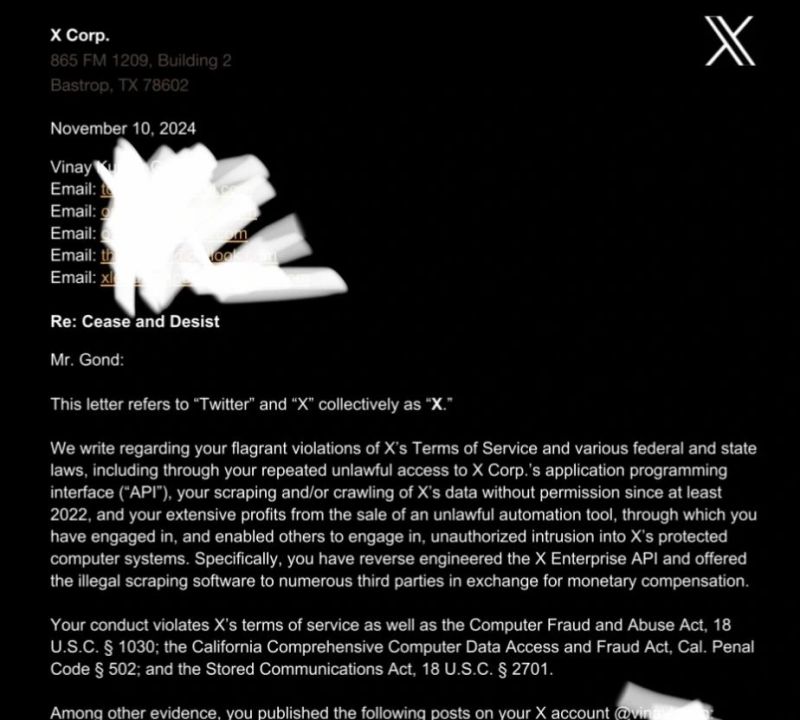
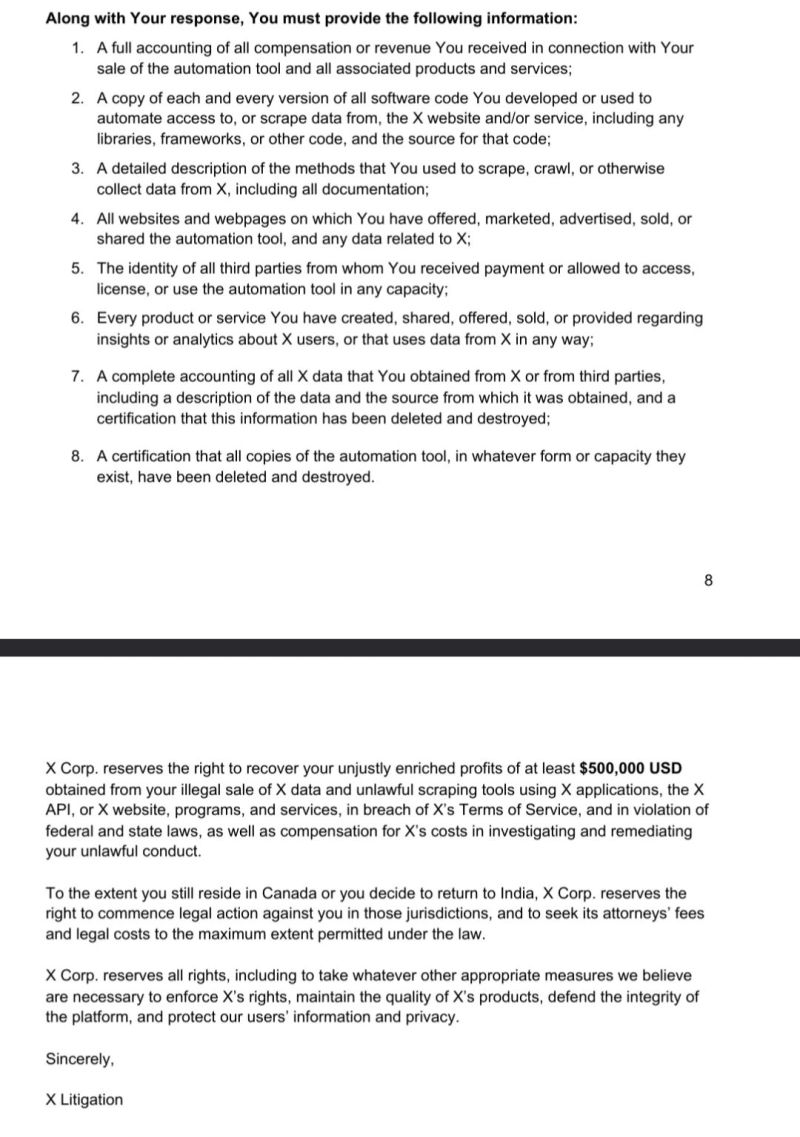
A 13-page cease-and-desist, account bans, and 30+ suspended customers.

The Narrative

With $15 in the bank and a toddler at home, I built infrastructure to extract structured lead intelligence from public social signals at a scale manual workflows could not support. The system worked commercially โ€” roughly $500k ARR within six months โ€” because it solved a real throughput problem for agencies and founders.

Then came the reset: a cease-and-desist from ๐•'s legal team citing unauthorized scraping and platform manipulation. Developer accounts were terminated, API access revoked, and 30+ customer accounts were caught in the blast radius of shared infrastructure.

VERIFIED: Read the original forum story and admin comments on Swapd.

The C&D was not the story โ€” it was the invoice for architectural debt. V1 optimized throughput; it under-invested in isolation, behavioral realism, and blast-radius control. V2 rebuilt around those constraints. The same principle now shapes Exit Protocol, where auditability and evidence integrity are product requirements.

Primary source: cease-and-desist correspondence (Nov 2024)

Redacted screenshots of the legal notice referenced in this report. Shared for engineering context โ€” not legal advice.

V1: The $500K "Hydra" Architecture

V1 was not a single scraper script โ€” it was distributed request orchestration. Platform rate limiting is multi-dimensional. V1 addressed Layers 1โ€“2 aggressively; Layers 3โ€“4 are where the system ultimately failed. Explore each layer below.

Layer 1: Per-Endpoint Limits

The visible layer: every API surface has its own bucket.

V1 approach: endpoint rotation. A request router distributed traffic across ~47 API endpoints, each with independent limits. Instead of exhausting one surface (e.g., user_lookup), the system combined responses from multiple paths and reconstructed full profiles. Lesson: beating Layer 1 buys a multiplier, not durability.

Diagram: Endpoint Rotation

Request
โ†’
Request Router
โ†’
API: user_lookup
API: user_timeline
API: list_members

V2: The Compliant & Sustainable Pivot

The new version isn't just "following rate limits better." It's architecturally different at every layer. V2 optimizes for QUALIFIED LEADS and SUSTAINABLE OPERATIONS, not just speed. Compliance is a design constraint, not an afterthought.

Layer 1: Official API Usage Only

No more endpoint tricks. V2 uses the official API with proper OAuth 2.0 (PKCE) for each user. We stay well below published rate limits (e.g., 50% max utilization) and use automatic backoff. This is non-negotiable.

Showdown: V1 vs. V2

The tradeoff is simple: V1 was a dragsterโ€”insanely fast, but it burned out. V2 is a Teslaโ€”fast enough, and built to run forever. The V1 speed was a vanity metric. 10,000 profiles/day, when properly analyzed, yields more qualified leads than anyone can handle.

V1 vs V2: Speed (Profiles/Day)

(Note: Y-axis is logarithmic to show the extreme difference)

V1 vs V2: Net Present Value (NPV)

(V1: $500K in 6 mo. | V2: $10K/mo for 5 yrs)

Metric V1: The Dragster V2: The Tesla
Speed 2,000,000 profiles/day ~10,000 profiles/day
Intelligence High (Behavioral Intent) High (Same Algorithms)
Risk High platform risk; C&D in ~6 mo. Designed for sustainable operation
Optimization Maximum Speed (Vanity Metric) Qualified Leads & Sustainability
Result $500K revenue, C&D, 30+ banned customers Sustainable business, protected customers

The Lessons

The hardest part of rebuilding wasn't the code. It was admitting that "moving fast and breaking things" applies to *your* things, not to platform rules. You don't own the platform; you're renting space. The rules are the price of admission.

Lesson 1: Compliance is a Design Constraint

Don't build fast and "fix compliance later." That's backwards. Design *for* compliance from day one. Constraints breed creativity. The technical challenge isn't "how do I bypass limits?" It's "how do I deliver maximum value *within* limits?" A defensible solution is a valuable one.

Lesson 2: Reputation Risk > Legal Risk

The real cost wasn't the C&D letter. It was the 30+ customers who got banned because of my architecture. Short-term revenue optimization destroyed long-term trust. V2 prioritizes customer protection over maximum revenue.

Lesson 3: Optimize for Longevity

V1 made $500K and died. A compliant V2 making $10K/month for 5 years is worth $600K, plus you get to sleep at night and keep your reputation. The math is simple. The best systems aren't the fastest; they're the most sustainable.

From This Report to Exit Protocol

The same architectural discipline โ€” blast-radius control, deterministic outputs, reviewable artifacts โ€” now applies to forensic litigation intelligence. Exit Protocol produces attorney-reviewable LIBR workpapers with SHA-256 integrity and source provenance.

V2 product (post-pivot): xleadscraper.com ยท Source: GitHub